What Am I Clapping For?
A few months ago, my husband Drew and I had our five-year-old grandson for the weekend while our daughter was traveling. One of the activities on our to-do list was for Drew to give him a lesson in shooting baskets.
Thanks to Drew, I often refer to our family as a “basketball family.” Drew was born naturally athletic, and basketball was always his favorite sport. Growing up in Manhattan, he was immersed in a basketball-focused culture. From the time he was eight, he played pickup games before and after school, as well as during recess.
When the two of us moved onto our farm in 1984, Drew played in a local rec league, which is where he first met many of the men who became his closest friends. We eventually covered some of our precious farmland with asphalt to create a basketball court that became home to a Wednesday afternoon pickup game that went on for twenty-seven years. No matter how chaotic things were at work, everyone knew Drew would be leaving the office promptly at 3:00 PM to get back in time for his 4:00 PM game.
When our son was in kindergarten and our daughter in third grade, Drew took time out of his demanding schedule to coach their teams, and he continued to coach them through middle school. His efforts were well-rewarded. Our kids inherited their father’s skill and passion for the game, and we loved cheering them on when they played for their high school teams.
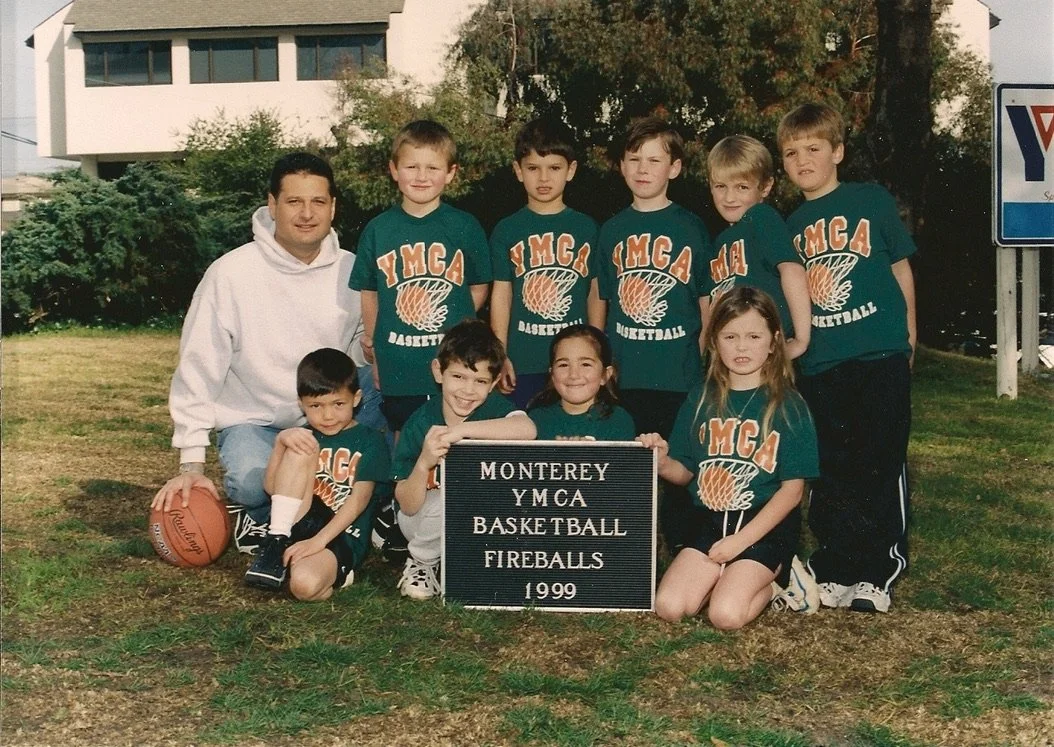
So when our young grandson stepped onto our court, he was stepping into family history. We hoped that he’d demonstrate both potential and interest.
“Bend your knees. Your power comes from your legs,” Drew instructed. “Aim for the square on the backboard.” Sitting in a green plastic chair off to the side, I cheered and took videos for our daughter.
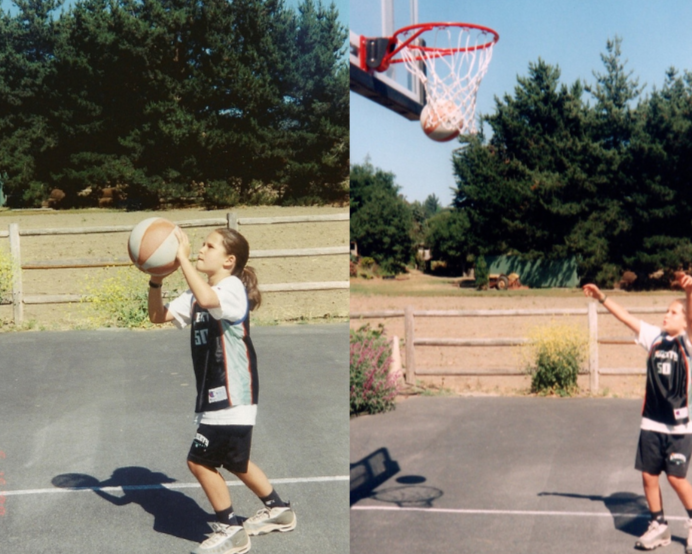
Myra’s daughter Marea practicing on their home court, 1999
Initially, our grandson missed most of his shots, making only about one out of ten. Each time the ball went through the hoop, I clapped with much enthusiasm. I’ve had decades of experience rooting for made baskets.
Sometimes, instead of shooting, our grandson would unexpectedly turn away from the hoop and kick the ball down an adjacent trail, playing a spontaneously made-up game before happily returning for more practice. Once, ball in hand, he looked up at the sky way above the hoop, and said with wonder in his voice, “What if when I shoot the ball it goes all the way up to the moon?” My husband patiently replied, “That’s not going to happen.”
As the practice session continued, I started to notice that by focusing my applause solely on one specific achievement, I was sending the message that only made baskets were clap-worthy. This left ninety percent of his shooting efforts—as well as the game he’d invented and his ball-flying-up-to-the-moon imaginings—not clap-worthy. Such a narrow definition of success left me with a question that stayed with me: What am I clapping for?
Soon after that weekend, Drew and I traveled to meet our son, his wife, and their 16-month-old son, who was very busy learning new words and mastering new skills. He had his own toddler-size plastic basketball hoop, and shooting baskets was one of his favorite activities.
When our grandson made a shot, all the adults would clap and cheer. We’d also applaud when he did something new or challenging. Sometimes, after accomplishing something on his own, our little grandson would break into a huge, delighted smile and begin to clap for himself.
Still pondering the impact of cheering for only certain types of accomplishments—and how easily we can become conditioned to perform for praise as much as for pleasure—we traveled to the countryside and stayed at a small inn. One night, after I'd fallen asleep in my first-floor room, the sound of guests stomping overhead woke me.
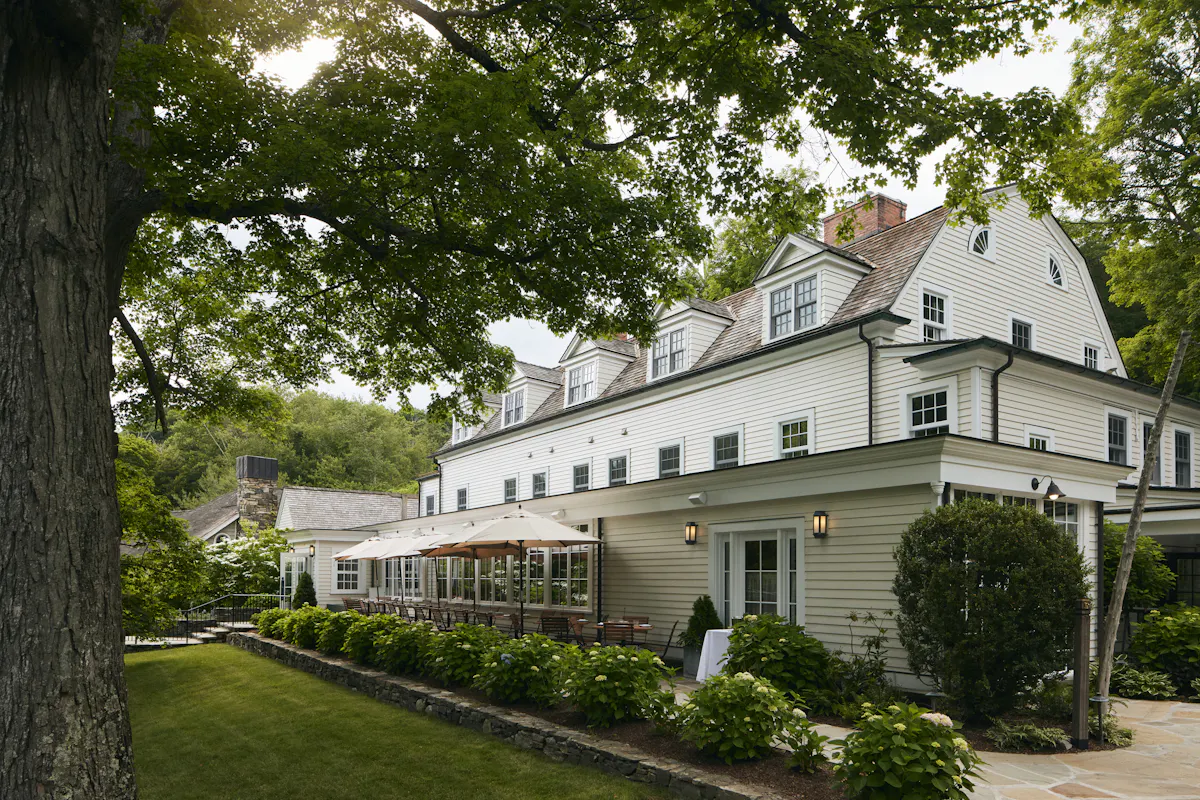
The Bedford Post Inn
I’m an exceptionally light sleeper, and situations like this usually get me so agitated that I can stay awake for hours. This time, I said to myself, “It’s okay. Don’t get upset. You can fall back asleep. Just relax.” I squished pillows against my ears and began to breathe deeply…and the next thing I knew, it was morning.
As soon as I realized that I’d quickly fallen back to sleep and hadn’t let aggravation overtake me, I unexpectedly began to smile and clap—just like my little grandson.
I was surprised to discover how good it felt to clap for myself. Instead of quickly rushing past what felt like a victory, I had my own mini-celebration.
Since then, I’ve been spontaneously clapping for myself for all sorts of reasons—from finally catching up on my bookkeeping to communicating my feelings honestly and succinctly. I feel happy every time I do it, and that happiness is magnified because it brings to mind my adorable grandson’s little hands and exuberant smile. I feel grateful to him for modeling this form of self-acknowledgement and self-appreciation for me.
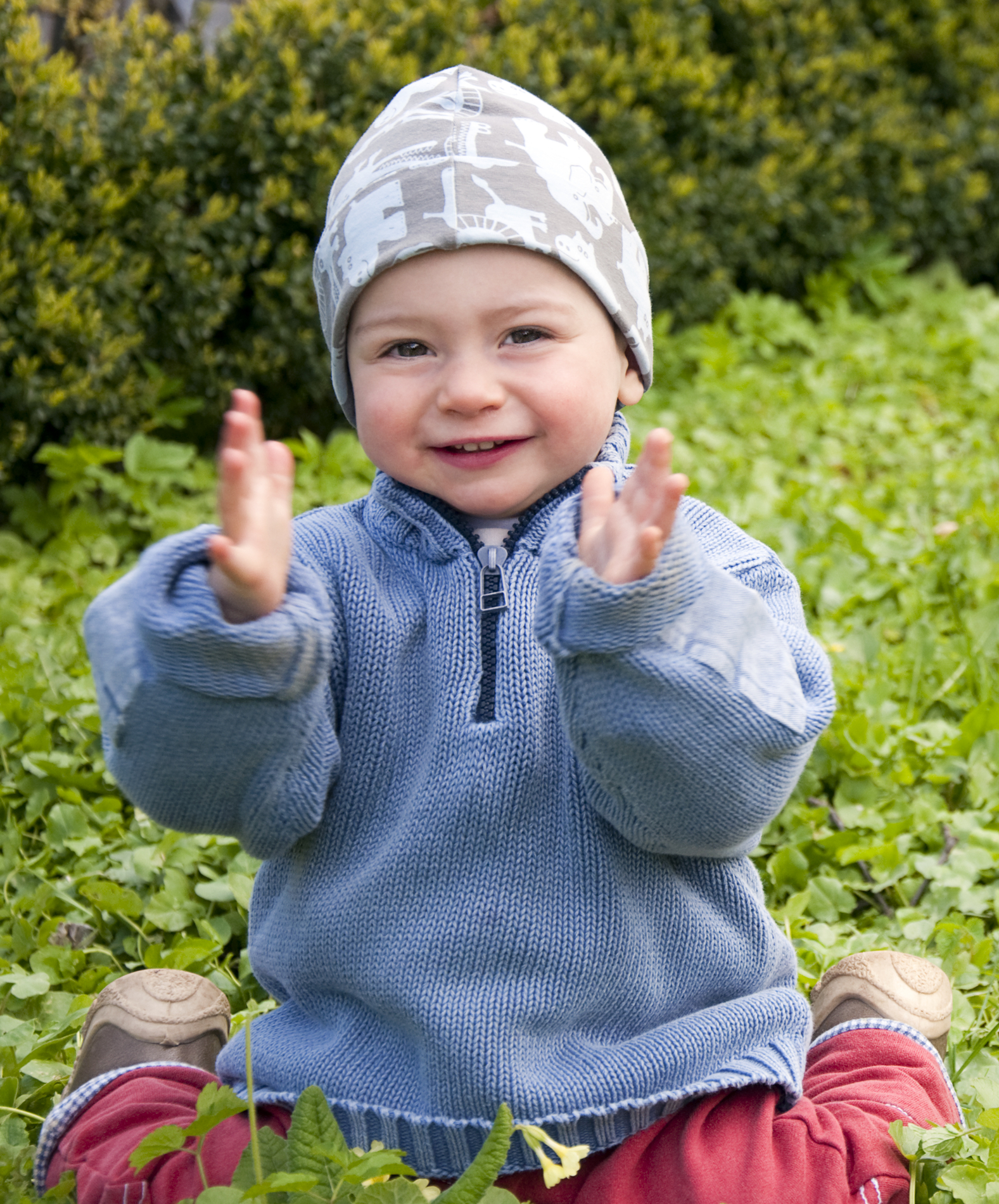
Stock photo by Pavla Zakova
Applause is a powerful form of positive reinforcement. It activates the brain’s reward systems, releasing neurochemicals associated with pleasure, motivation, and social connection. When what we do is met with enthusiastic recognition, it becomes more likely that we’ll want to repeat those behaviors.
Time with my grandsons has made me more mindful about what I’m clapping for. While I still celebrate made baskets, I’m also remembering the importance of cheering for the imagination that aims for the moon, the resilience that stays calm in the dark, and the joy that comes from learning, growing, and setting ourselves free.