
An Empowering Prescription For Chronic Pain
Please don’t be put off by the title of today’s post if you aren’t someone who experiences chronic pain. I pitched this article to Spirituality & Health magazine because I believe that psychotherapist Nicole Sachs offers profound insights into the far-reaching impacts of emotional suppression, and that the practices she teaches can benefit everyone. After two months of exploring her work, I’ve found it to be deeply illuminating, liberating, and healing—which is why I’m thrilled to share it with you.

Psychotherapist Nicole Sachs offers a road to healing chronic pain and anxiety that guides us back to our authentic self
Twelve years ago when I was on the cusp of turning 50, a health crisis forced me onto a healing journey that revealed the inseparability of my emotional and physical well-being. It began with terrible nerve pain in one foot that quickly spread to both feet and hands. Soon my torso and limbs were overtaken by alarming, creepy-crawly sensations. I saw more than a dozen health professionals, but none were able to provide a definitive diagnosis or offer an effective cure.
Eventually, I found a doctor who recognized the connection between my trauma history, high stress level, and physical health. She explained that when the nervous system gets stuck in an activated state, the body stays in survival mode, which puts healing on hold. Instead of repairing tissue, fighting infection, or digesting food properly, stress hormones flood the system, inflammation rises, muscles remain tense, and immunity weakens. My fear and anxiety only amplified this dysregulation.
The inseparable connection between physical and emotional health helps explain why chronic pain has reached epidemic proportions in the United States. According to the CDC, 24.3 % of American adults (over 63 million people) were plagued by chronic pain in 2023, up from 20.9% in 2021.
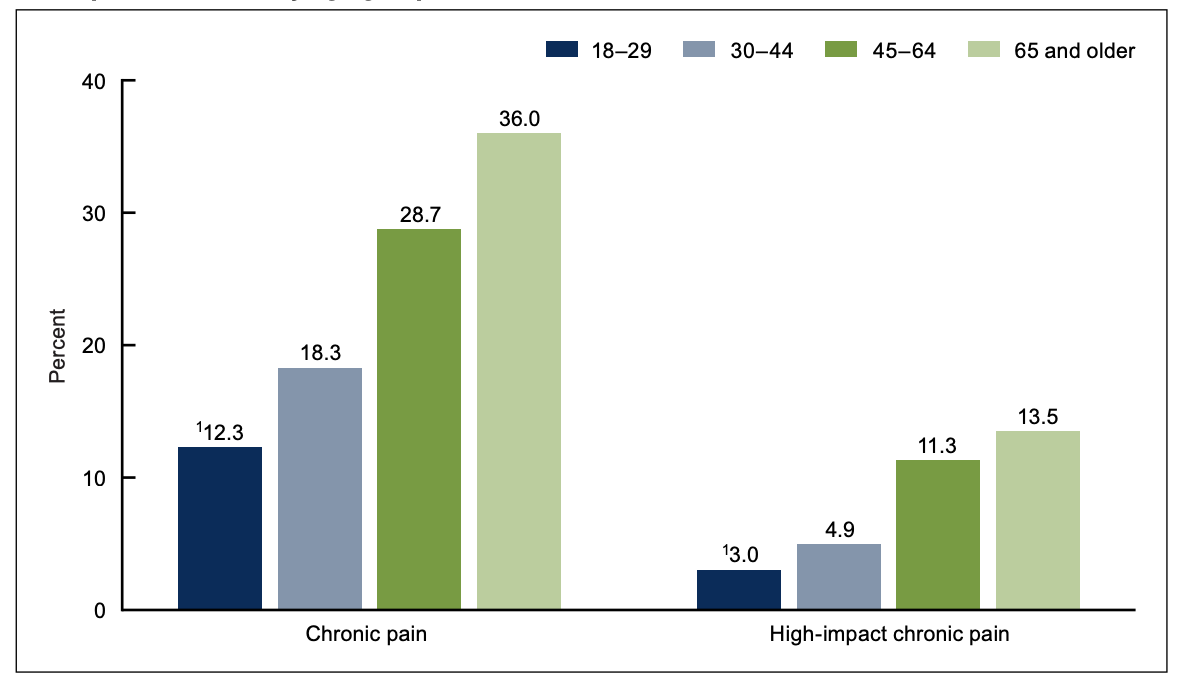
Percentage of adults age 18 and older with chronic pain and high-impact chronic pain in the past 3 months, by age group (2023, United States National Center for Health Statistics)
The question then becomes: How do we calm our nervous system enough to facilitate true healing in an overstimulating world filled with countless stressors large and small?
Nicole Sachs—psychotherapist and author of the new book, Mind Your Body: A Revolutionary Program to Release Chronic Pain and Anxiety—has been tackling this issue for 25 years. She offers a solution based on her conviction that most chronic pain is fueled by repressed emotions and stored traumas that the nervous system interprets as so threatening, it reacts to them as it would to any dangerous predator.

Sachs says that the nervous system tells the brain to send signals of pain to “protect and distract” us from our overflowing repressed emotional reservoir. Her insights and program have helped tens of thousands of people heal themselves from a long list of chronic conditions.
Here is my conversation with her:
Myra Goodman: Nicole, you overflow with youthful vitality and vibrant health. Yet your mind-body approach to healing began in your early twenties with a terrible diagnosis.
Nicole Sachs: At 19, I suddenly developed such excruciating back pain I couldn’t even walk. Doctors diagnosed it as degenerative spondylolisthesis [misaligned vertebrae]. They told me I’d have to restrict activity for the rest of my life and that I’d never be able to carry children. Eventually, I discovered the work of Dr. John Sarno, a physician at New York University who pioneered the radical idea that most chronic back pain stems from psychological stress and repressed emotions. He believed that our unconscious mind creates physical pain as a defense mechanism in its attempt to divert our attention away from feelings it deems too threatening to face directly.
Dr. Sarno taught me that although my pain was not in my head, the real cause was my dysregulated nervous system, not my structural abnormalities. To my astonishment, once I began to excavate my repressed emotions, my back pain completely disappeared. This led me to learn everything I could about mind-body medicine, and I went from being Dr. Sarno’s patient to his devoted colleague. He died in 2017, but I continue to carry the torch and evolve his teachings.
This work gave me my life back. I’ve had three babies, exercise daily, and travel the world—all without chronic pain, despite the fact that I still have spondylolisthesis. My life’s mission is to rescue as many people as possible from the despair I once experienced.
Dr. Sarno was best known for resolving back pain, but you say your practices help people with a vast array of chronic conditions.
In my 25-year career, I’ve witnessed transformations from such a wide variety of conditions it would be impossible to inventory all of them. The list includes muscular and nerve pain, fibromyalgia, chronic fatigue, migraines and headaches, stomach issues, flaring autoimmune symptoms, chronic anxiety, long Covid, and many more. The important thing is not the specific label but the brain science underneath. Repression with no healthy outlet cannot be maintained indefinitely. Eventually, the pain needs to be felt somewhere.
I tell people not to ignore conventional medicine. Go to the doctor, get checked out, take the tests. But for the many who’ve been told nothing can be found or that there isn’t a cure, I want them to know it’s not the end of the story. To a great extent, the Western medicine model has gotten it wrong. Not considering the mind-body system as a fluid, whole system causes immeasurable suffering. If we want to thrive, we need to debunk the programming that physical issues always require physical solutions. In the case of chronic conditions, rarely will targeting the part of the body that is hurting provide a long-term solution. It’s simply not where the pain is really coming from.
Imagine this: Your house is on fire and the alarm is blaring. But what if the firemen arrived and sprayed water at the alarm? In our bodies, the pain is the alarm. Alarms are important because they get our attention, but the real fire is our unresolved trauma and repressed emotions, not the alarm. My work is about teaching people how to put out the fire instead of spraying water at the alarm.
Your main fire-dousing technique is called JournalSpeak, which is basically a no-holds-barred 20-minute session of radically honest journaling that is meant to excavate and discharge our most difficult emotions. It’s almost like an anti-gratitude journal, right?
JournalSpeak is a form of targeted self-expression specifically designed to get to the heart of our repressed emotions. For twenty minutes every day, it gives us total permission to explore every thought and emotion without censor, including our full-blown rage, shame, regret, grief and terror. All humans have unconscious resentments, even toward the people we love most. When we’re JournalSpeaking, we’re always forgiven for anything we write, no matter how ugly, angry, immature, or inappropriate it may seem. JournalSpeak is such a powerful tool because it’s completely uncensored and because what we write doesn’t have to be objectively true.
This practice must be approached with the understanding that our nervous system perceives our repressed emotions and stored trauma as an even greater threat to our life than physical pain. JournalSpeak teaches our conscious mind that we can face all of our feelings without needing physical pain to distract us. Imagine JournalSpeak as the bailing out of a sinking boat. Scoop by scoop, you’re making sure your emotional reservoir doesn’t spill over so that your brain can stop sending pain signals to your body.
My book goes into JournalSpeak in great detail, but I always advise people to start with Dr. Sarno’s recommendation of making lists for three key categories that they can always refer to the get their sessions going. The first, “Childhood” or past stressors, includes old traumas and unresolved memories. The second, “Daily Life,” focuses on current stressors, such as work, finances, health issues, relationships, and everyday challenges and responsibilities. The final category, “Personality,” articulates the specific traits that contribute to your stress, such as your insecurities, perfectionism, or fear of conflict.
I’ve been experimenting with JournalSpeak in anticipation of this interview and have been stunned by both the intensity and the range of emotions that are surfacing—powerful feelings that were so deeply buried I didn’t even know they existed. What do you advise people to do with everything that comes spewing out onto the page?
Unearthing and honoring our most difficult feelings can be hard, but we do it every day so that our bodies can stop screaming. It’s important to remember what Dr. Sarno used to say: “You don’t have to change your life, you just have to know how you feel about it.”
After writing, people should take about ten minutes to meditate and offer themselves kindness. Put your hand on your heart, take a breath, and remind yourself that your feelings are just feelings. They can’t hurt you. Self-compassion helps retrain your nervous system to feel safe. It makes the whole practice not just a purge but a path to healing.
Once you’re done, it’s time to throw it away. Tear it up or delete it from your device. This part is essential because it lets your unconscious mind know it’s safe to write anything. The whole point is to cleanse yourself of those negative feelings so that you no longer need to carry them.
Your program has three facets—Believe, Do the Work, and Patience and Kindness for Yourself—which you refer to as the three legs of a stool.
Belief is essential in a society where we’ve been conditioned to give all our power to doctors and take pills or undergo surgery for pain relief. Every chapter of my book includes a personal success story to help people have faith that they, too, will heal. Trusting the process sends signals of safety to your nervous system.
“Do the Work” is about showing up for yourself and doing your JournalSpeak.
I can’t overstate how much an orientation of “Patience and Kindness” facilitates healing, or how much hating on ourselves contributes to our symptoms. Our nervous system interprets wanting to be different than we are as another threat to guard against. When we’re compassionate toward ourselves instead of judgmental, there’s far less content being dumped into our emotional reservoir.
Just from marinating in your work for a few weeks, I’m seeing positive shifts in my relationship with myself. Instead of lamenting about what’s wrong with me when symptoms arise, I now turn toward myself with kindness, curious about what’s really going on.
JournalSpeak helps us slow down and stop operating on autopilot long enough to discover the intricacies of who we really are. Human beings are in a constant struggle between authenticity and attachment, because who we are and how we feel inside often conflicts with what our family, workplace, and society expect of us.
Pain is an invitation, not a life sentence. It can be an entry point into a life of more clarity, openness, and presence. This work helps us quiet down and listen to what our pain is trying to tell us. I want everyone to know that our bodies are beautifully equipped to heal when given the right support.
**
Nicole Sachs, LCSW, is a psychotherapist and author of Mind Your Body: A Revolutionary Program to Release Chronic Pain and Anxiety. She hosts The Cure for Chronic Pain podcast and offers courses and other resources on her website. Find her on Instagram @nicolesachslcsw, and on YouTube.
