
Break Free from Chronic Guilt
One of the benefits of writing for Spirituality & Health magazine is that I get to interview authors about new books that catch my interest. I learned a great deal about the complexities and roots of chronic guilt from psychiatrist Jennifer Reid, MD—and why it so often affects women more than men. While I was working on this piece, I began to notice how frequently the voice of guilt arises in my own mind, and how automatically I obey it. Bringing awareness to the role and power of guilt in our lives can begin to loosen its grip, freeing us to live in closer alignment with what we truly want and need.

Guilt is a tricky emotion. On one hand, there is adaptive guilt—the uncomfortable emotional signal that arises when we believe we’ve stepped out of alignment with our values. It can nudge us to extend more kindness and generosity, as well as make repairs when we’ve caused harm or fallen short in our relationships.
On the other hand, there is maladaptive guilt—or excessive guilt—which manifests as the voice of a relentless inner critic telling us we’re never doing enough. This type of guilt can make life feel like an endless series of obligations, quietly eroding our energy, freedom, and joy.
Psychiatrist Jennifer Reid, M.D., author of the book Guilt Free: Reclaiming Your Life from Unreasonable Expectations, explains that humans are evolutionarily wired to feel guilt. According to Reid, guilt works closely with empathy—both of which are social emotions that children learn around age three. “If we think we understand the pain someone is feeling, and if we believe that we’re responsible for causing it, we will experience a powerful motivation to attempt repair,” she says. “Yet guilt quickly becomes maladaptive when the feeling that tells us we’ve done something wrong becomes pervasive without contributing to healthy relationships.”
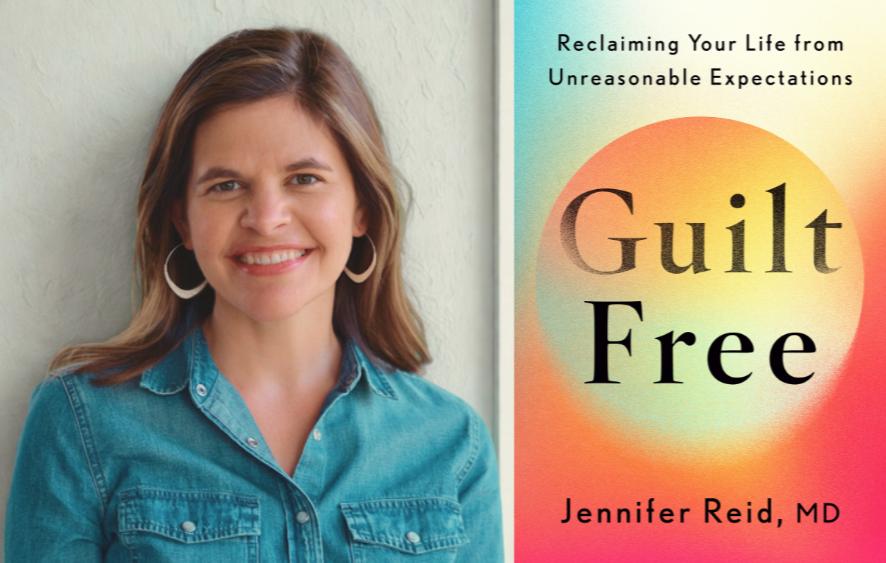
Reid explains that excessive guilt generates unhealthy behaviors like perfectionism, people-pleasing, self-criticism, and self-denial. “Guilt can drive our decision-making so much that we agree to activities we dislike rather than experience the guilt of saying no. When left unchecked, guilt can lead to anxiety, overwhelm, depression, and other health problems.”
While guilt can be a very effective motivator in the short term, it often leads us to make decisions that betray our own needs and desires, which is unsustainable in the long term. Over time, excessive guilt takes us further and further away from our authentic self—the person we are truly meant to be.
The Guilt Equation
Reid wrote a book devoted to guilt because so many of her female patients struggled with this issue. “Once I realized that guilt was the cause of so much suffering, I looked around for helpful resources but found very few. This motivated me to uncover the roots of excessive guilt and create practical strategies to help people liberate themselves from its grip.”
Her research led Reid to conclude that guilt is the result of the gap between what we expect of ourselves and how well we think we are meeting those expectations. She introduces what she calls the “Guilt Equation”: Guilt = Expectations – Reality. “Expectations” are the internalized standards we use to measure ourselves, and our beliefs about what it means to be a good person across the many roles we occupy. “Reality,” by contrast, reflects our subjective assessment of how well we’re actually meeting those standards, which are often far more demanding and idealistic than we consciously recognize.
Reid says, “Guilt makes us believe that we must try harder and give more. But the truth is, perpetually falling short of an unreachable ideal is not the same thing as failing.”
Excavating Our Expectations
In Guilt Free, Reid distills the unrealistic expectations women have been conditioned to internalize into four types that she calls the “Four Furies.” By identifying and illuminating them, Reid hopes women will begin to recognize how these patterns operate in our own lives, which is the first step toward liberation. “You can’t push back on a shadow,” Reid asserts. “That’s why these expectations must be named and understood—so we can drain them of their power over our lives.”
1. Constant Caretaking
Women are disproportionately expected to prioritize the needs and desires of others above their own. “We are expected to be caretakers for family members, friends, even colleagues,” Reid says. “When we put our own needs first, we feel guilty. This guilt pushes us to override our own needs in favor of someone else’s—a pattern that leads to exhaustion and resentment.”
2. Hyper-Accountability
Reid believes that from a young age, women have been socialized to pay careful attention to other people’s emotions—and to take responsibility for them, no matter how impossible and inappropriate this task may be. Reid encourages women to explore the questions:
How does the attempt to control others’ emotions show up in my day-to-day life, and how well is it working?
How much of this pattern is driven by a desire to avoid uncomfortable emotions, despite knowing they are an inevitable part of life?
3. Seeking Perfection
Women are often socialized to equate imperfection with failure, so we expect ourselves to do everything flawlessly—not merely adequately. This pressure shows up in how we perform at work and at home; how we parent; how we behave in relationships; how fit and ageless we appear; and even in our reluctance to allow ourselves to feel certain emotions, such as anger, frustration, or resentment.
“When perfection becomes the standard—a pressure now amplified by the influence of social media—even normal human limitations can trigger guilt and fuel chronic self-criticism,” Reid says.
4. Trying to Have It All
Reid believes that while opportunities for women have expanded over time, traditional expectations around housework and caregiving have not diminished proportionately. Women are expected to build meaningful careers, nurture relationships, manage households, stay physically fit, and remain emotionally present all at once—making true balance nearly impossible to achieve.
“The promise of ‘having it all’ has become an impossible standard that leaves many women feeling perpetually behind, no matter how much they accomplish. You can’t win when you expect yourself to be superhuman,” Reid says.
Letting Guilt Go
Reid explains that simply recognizing the expectations behind our guilt begins to loosen its grip. To begin breaking long-held patterns, she advises people to pause when that familiar pang arises. Instead of obeying guilt’s dictates right away, explore what’s going on with curiosity and compassion. We can ask ourselves: Am I trying to meet a standard rooted in perfectionism, people-pleasing, or the belief that I am responsible for someone else’s happiness?
Perhaps the guilt is a meaningful signal worth listening to, like the feeling that it’s past time to visit an aging, infirm relative. Or perhaps it’s something to challenge—like guilt for not immediately replying to a casual text.
If we determine our guilt is of the maladaptive variety, Reid recommends telling ourselves: This is guilt and it’s uncomfortable. It’s tricking my mind into thinking that I’ve done something wrong, but in reality, there is nothing I need to do or fix right now.

Reid assures us that as we practice self-awareness and self-compassion, set healthier boundaries, and allow others to take responsibility for their own emotions, guilt will gradually weaken its hold. Rewiring our habitual responses and building new emotional muscles takes time and practice.
“If you’re a human in modern society, you will inevitably disappoint people sometimes. It’s not possible to be everything to everyone,” Reid says. “An important lesson many of us must learn firsthand is that disappointing people by setting healthy boundaries will not destroy them or us.”
Reid reminds us of the rewards that come with releasing excessive guilt. “Instead of feeling beholden to what we think we should be doing, we become free to live in alignment with what we truly want and need. Finally, we reclaim our right to make choices that honor our own happiness and well-being.”
Jennifer Reid, M.D., is a board-certified psychiatrist and clinical assistant professor at the University of Pennsylvania. She earned her medical degree from Columbia University and completed her psychiatry residency and fellowship in mood disorders at the University of California, Los Angeles.