
What Writing Gives Us That AI Can’t
When I first went to college, I created a custom major called “Human Perspectives” that combined the study of religion, philosophy, and sociology. I hoped to discover beliefs and customs that people all over the world shared to help me understand more about what it means to be human.
My explorations of other cultures led me to spend the second semester of my sophomore year abroad in Gujarat, India. I was one of five students taking part in a rural development program, and the other four were graduate students from Ivy League schools. Far from any of them being kind and taking me under their wing, they all felt far superior to me and did their best to ignore my presence.
In early January 1982, after spending one night in New Delhi, we boarded a bus for the long journey south to Ahmedabad, where we’d be living at Gujarat Vidyapith—a university founded by Mahatma Gandhi in 1920. Our journey took us through the state of Rajasthan, and what I witnessed along the way was enthralling. We passed group after group of brightly dressed nomadic people traveling on foot through the desert, accompanied by camels laden with their belongings. A few of the men were carried on beds suspended between long poles.

The student who had been most condescending toward me sat right next to the window, but he rarely looked out. Instead, he spent his time with his head down, reading a thick textbook about India that he’d brought with him. I had a hard time believing he’d learn more from those pages than he would by taking in the incredible scenes unfolding around him.

Over four decades later, I still think about that student when I’m someplace beautiful and the majority of the people surrounding me are more interested in engaging with their phones than taking in the real world.
As someone who grew up with a rotary phone wired into the wall that had to be shared by my whole family, it’s hard to believe how much of our lives are now centered around our handheld devices. We’re spending hours on them every day, checking them dozens—sometimes hundreds—of times.

The dramatic change in how humans are living crept in gradually enough to make it almost imperceptible. Each new function, source of entertainment, and convenience made our phones more and more indispensable, until they became a central part of our daily lives.
Just one example of the negative impacts of our phones claiming so much of our time and attention was highlighted in a recent 2026 study of 600 teenagers. It found that the adolescents who perceived their parents to be distracted by their devices were more likely to report insecure emotional attachments, along with feelings of being ignored, unimportant, or angry.
If we’d been able to get a peek into the future twenty years ago, I believe we’d have been staggered by both the gifts our phones would eventually bestow upon us as well as the time and attention they would come to rob from us. At this pivotal time in human history, AI is suddenly offering us another extraordinary leap, with the potential to impact our lives even more profoundly.

But what if this time we pause to consider not only what the technology can do for us, but also what we might lose if we allow it to do too much? Rather than waiting until new habits become second nature, we still have the opportunity to decide what we want to preserve.
Personally, I’ve been learning through trial and error what boundaries I want to set with AI when it comes to my writing. When I first began to use it as a collaborator and editor, it felt like a huge boon to have a talented, dedicated helper that worked with lightning speed in constant service to me. But after a few weeks of increasingly relying on AI, I began to notice that much of the joy and enthusiasm I used to feel when I sat down to write was missing.
As my dissatisfaction began to grow in tandem with my ever-increasing use of AI, I finally realized that since embracing AI, I rarely finished more than one paragraph without turning to it with a question or problem to solve. I saw that I wasn’t enjoying my writing time because I never had the chance to get into a flow state where the words just poured out of me—one thought leading to an idea I’d never thought of before, or a long-buried memory I was grateful to unearth.
As AI got better at helping me and I became more dependent on its help, my writing was constantly being interrupted, and the magic of the writing process was beginning to disappear. It was as if a song I loved began to pause every few seconds. No longer a pleasing experience, I’d just want to turn it off.
Writing isn’t just about producing a finished product—it’s also about how we are impacted and shaped by the process of writing. Without AI, I’m forced to explore the heart of what I am feeling and thinking more deeply, and to employ patience and determination as I work to express it. Every time I push through a difficult roadblock, my skills improve, and I get to enjoy the satisfaction that comes with overcoming a challenge.

I worry about what will happen to our humanity if we outsource the very activities that help us become our best selves. Technology has the potential to enrich our lives in extraordinary ways, but my hope is that we can harness its benefits in ways that help us flourish instead of diminishing our creativity or ability to reach our full potential.
I still use AI in my writing, but I am careful not to let it block my flow. Now, I turn to AI for proofing and ideas to ponder only when I feel like I’ve used up my creative energy and am ready for a break. While I’m incredibly grateful for the help that AI provides, I’m determined not to lose my own skills and joy in the process.
More than four decades after creating my college major in Human Perspectives, I’m still fascinated by what it means to be human and how we can live our most expanded and fulfilling lives. I believe that taking the time to explore our inner world is an essential part of that journey, and writing is one of the most powerful tools I’ve found for doing just that.
The Many Benefits of Expressive Writing
I first started writing fourteen years ago at an Esalen workshop with the highly acclaimed author and writing teacher, Laura Davis. It took place two months after my father had died, and my grief felt vast and complicated.
Laura’s free-writing method and writing prompts took me places I could never have gone any other way. I told her it felt analogous to an angiogram—like an exploration of the deepest, most difficult-to-access parts of myself. Through writing, I brought my past out into the light to be explored and processed. It was one of the most transformative and healing experiences I’d ever had, and I’ve been writing and working with Laura ever since.
Because I think writing is one of the most powerful portals to self-discovery, I’m delighted to be hosting a free writing workshop with Laura next week—“Explore the Flavors of Your Life”—on November 14, from 10:00 AM to noon Pacific, and I hope you will join us.

Writing can help us become more aware of what we think and feel, where we’ve come from, how we’ve grown, and where we want to go. Here are just a few of the documented benefits of expressive writing:
Build resilience. Writing helps us process difficult experiences and develop the capacity to face future challenges. It creates the space to recognize, name, and work through complicated feelings.
Understand ourselves better. Writing helps us turn scattered memories, thoughts, and experiences into coherent narratives. It deepens self-awareness by revealing patterns, beliefs, desires, and feelings we might not otherwise recognize, and can help us approach our past experiences and present struggles with greater understanding and self-compassion.
Shift our perspective. Writing allows us to revisit experiences, consider different interpretations, and discover new possibilities. It encourages reflection, strengthens understanding, and helps us integrate new insights.
Exercise our brain. When we wrestle with ideas and language, we’re practicing important cognitive skills. Writing engages multiple brain systems as we retrieve memories, organize thoughts, choose words, and translate feelings into language.
Food as a Portal to Memory, Identity, and Self-Discovery
In our free two-hour online workshop with Laura, you’ll experience the many ways food memories provide evocative doorways to our past and subconscious. Food is not just sustenance—it’s primal, visceral, and overflowing with sensory detail. It reveals a tremendous amount about our cultures, families, and deepest hungers.
Through a series of compelling writing prompts, Laura will guide us to places we didn’t expect to go. We’ll learn new things about ourselves, the forces that shaped us, and what sustains us and brings us joy. Themes that may arise include family rituals and traditions, sensory delights and forgotten pleasures, and memories and nostalgia for foods that belong to another time.
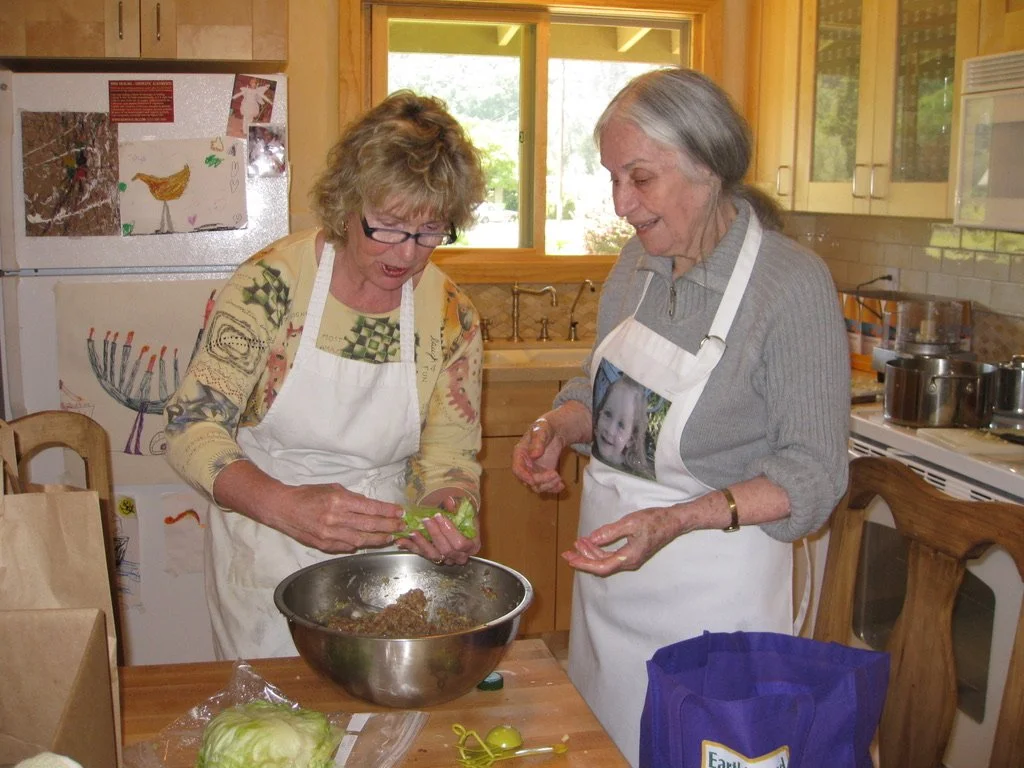
Myra’s mother Edith (right) teaching chef Pamela McKinstry how to make her stuffed cabbage recipe for Myra’s cookbook, The Earthbound Cook (2009)
In Laura’s recent Substack post, she shared some of her favorite writing prompts about food to get us thinking. Here are a few to ponder, and I hope they whet your appetite for our upcoming free workshop:
Tell me about the first thing you learned to cook and how you learned to cook it.
Imagine that your childhood kitchen table could talk. Have it tell the story of your family. What did the table see? What did it witness? Write in the voice of the table.
Tell me about a time you fed someone.
Tell me about a food that’s gone extinct.
Tell me about all the kinds of hunger you have known.
Tell me about a cooking disaster.
What makes your mouth water?