Authenticity is Good for Your Health
On the rare occasions when my father, Mendek Rubin, spoke about the three years he was imprisoned in Nazi forced labor concentration camps during WWII, he only shared stories about how he managed to stay alive. He recounted two acts of life-saving kindness (one by his sister Mila, and another by his cousin Stanley), the times he got very lucky, and innovations he devised that helped him survive. But more than anything, he emphasized what he believed was his most important strategy: to always use his limited energy wisely. This principle stayed with him long after the war ended.
My dad went on to become a highly successful inventor, known for his sharp observation skills and pragmatic approach. Years later, on a quest to liberate himself from decades of unrelenting depression, he turned those same qualities inward. Over time, he began to see that one of the biggest drains of his energy was the quiet, constant effort of trying to become who he thought others expected him to be—his struggle to “measure up.”
My father wrote, “It wasn’t until I was well into middle age that I finally decided to stop wasting my energy seeking approval from others. That way of living had only led me away from the source of my being, toward despair and loneliness. Instead, I began to focus my resources on truly loving myself for who I was. As humans, we’re so well trained that if we don’t watch ourselves, we end up doing what everyone else thinks is proper instead of what fulfills us.”

So much of my father’s healing journey was about recognizing, releasing, and replacing the conditioned beliefs and patterns that drained his energy and estranged him from his authentic self. While he was born in 1924, the messages we receive today are far more constant and pervasive. In addition to what people have always absorbed from their families and communities, we are now surrounded by a steady stream of input—from the internet, social media, and the world at large—telling us who to be, what to think, and what we must do to belong.
With so much time focused outward, most of us are spending less time turning inward to stay in close touch with our feelings and needs.
This disconnection can also eventually impact our health. In his bestselling book, The Myth of Normal, acclaimed physician Gabor Maté explains that when we repeatedly override our own needs or push down our honest emotional responses, the body can remain in a prolonged state of stress. Over time, that ongoing strain can affect immune function, increase inflammation, and interfere with the body’s ability to regulate and repair.
Maté lists the following traits—all of which require a person to ignore or suppress how they feel and what they need—that he often witnesses in people plagued with chronic illness.
An automatic and compulsive concern for the emotional needs of others, while ignoring one’s own.
A rigid identification with social role, duty, and responsibility.
An overdriven, externally focused multitasking hyper-responsibility, based on the conviction that one must justify one’s existence by doing and giving.
A repression of healthy, self-protective aggression and anger.
The harboring and compulsively acting out two beliefs: “I am responsible for how other people feel” and “I must never disappoint anyone.”
Maté explains that these characteristics are conditioned patterns, most developed when we were young to ensure our survival. He writes, “No one wakes up in the morning and decides, ‘Today I’ll put the needs of the whole world foremost, disregarding my own,’ or ‘I can’t wait to stuff down my anger and frustration and put on a happy face instead.’ Nor is anyone born with such traits: if you’ve ever met a newborn infant, you know they have zero compunction about expressing their feelings, nor do they think twice before crying lest they inconvenience someone else.”
Whether physical or emotional, Maté views illness as the body letting us know that we’ve strayed from our core. While illness is not the authenticity instructor anyone would wish for, major calamities of body and mind serve as a loud summons from essential parts of ourselves that we have lost touch with or ignore. My father’s summons came in the form of unrelenting depression and an inability to enjoy his life. Mine came in the form of persistent anxiety and a health crisis.
Maté says that we can get better at hearing and heeding the more subtle signals our body is constantly communicating before it needs to scream to get our attention. He writes, “If the authentic self can be covered by many layers of limiting self-belief and conditioned behavior, it is never obliterated. It continues to speak to us through the body. We can learn to heed the messages the body sends by learning its language.”
Maté offers the following self-inquiry questions to help illuminate the “what, how, and why” behind the people-pleasing beliefs and behaviors that do not serve us. He encourages revisiting them regularly—daily or weekly—and writing responses out by hand to access to the unconscious more deeply and reduce digital distractions. Most importantly, this inquiry is meant to be practiced with gentleness, self-compassion, and acceptance.
Question 1) In my life’s important areas, what am I not saying no to?
Question 2) How does my inability to say no impact my life physically, emotionally, and interpersonally?
Question 3) What bodily signals have I been overlooking? What symptoms have I been ignoring that could be warning signs, were I to pay conscious attention?
Question 4) What are the hidden beliefs and stories behind my inability to say no?
Question 5) Where did I learn these stories?
Question 6) Where have I ignored or denied the “yes” that wanted to be said?
Not only can stifling a “no” impact our wellbeing, so can withholding an authentic “yes.” Maté asks, “What have you wanted to do, manifest, create, or say that you have forsaken in the name of perceived duty or out of fear? What desire to play or explore have you ignored? What joys have you denied yourself out of a belief that you don’t deserve them, or out of a conditioned fear that they’ll be snatched away?”
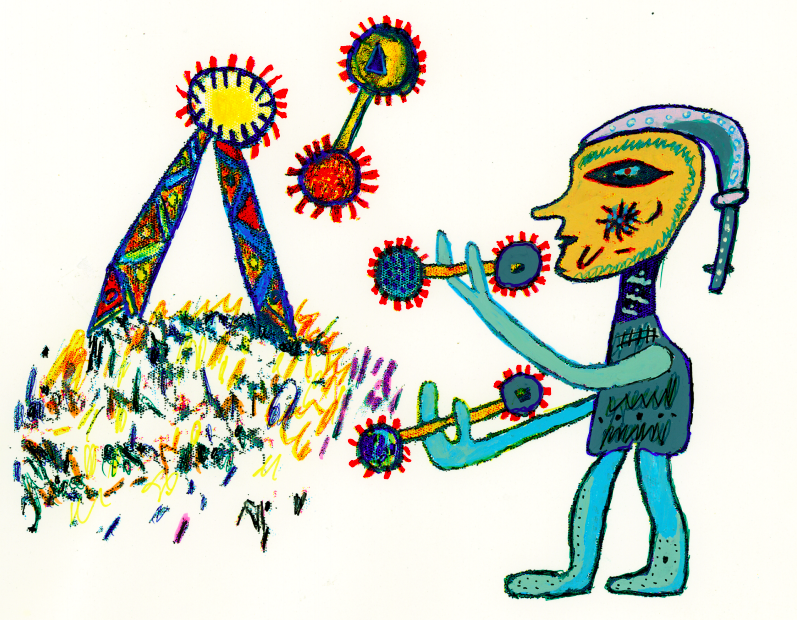
Artwork by Mendek
In my father’s case, once the energy he’d formerly spent trying to please other people was no longer being drained away, it became available for something else entirely. A wellspring of creativity and self-expression opened up, allowing him to share his unique gifts with the world. He wrote. He painted. He explored photography. He even built a wonderland in his garden, filled with semi-precious stones.
My father is a powerful example of someone who learned to stay totally true to his authentic self—and was only more beloved for it. What a miracle it was for a man with his history to become so joyful and free. My ongoing goal is to follow in my dad’s footsteps—to stop using my energy trying to measure up, and instead focus on being fully, authentically me.