Wiping the Slate Clean
I recently undertook an experiment that turned out to be surprisingly illumining. It all started with an email that arrived in my inbox from the brilliant life coach Martha Beck titled “Why Always Never Works.”
Martha wrote, “Lately I’ve been thinking about two words that cause enormous trouble: ‘always’ and ‘never’… If you’ve ever told someone ‘you always do this’ or caught yourself thinking ‘I never get it right,’ you know how quickly those words can whip up conflict—with others or within yourself.”
Recommending replacing those absolutist words with more flexible and nuanced ones such as sometimes and maybe, Martha wrote, “It may sound small, but the shift it creates is real. That one little swap starts to move you from judgment to curiosity, and immediately everything softens.”
Because I was a week away from taking a Hawaiian vacation with my husband, I applied Martha’s advice to one of my absolutist beliefs: I always hate to fly. I had never before questioned whether or not this statement was completely accurate. Of course I always hate to fly! My long list of reasons include:
I hate airports—the artificial environment, the crowds, the overstimulation.
I hate so much time waiting, all under the constant specter of frustrating delays.
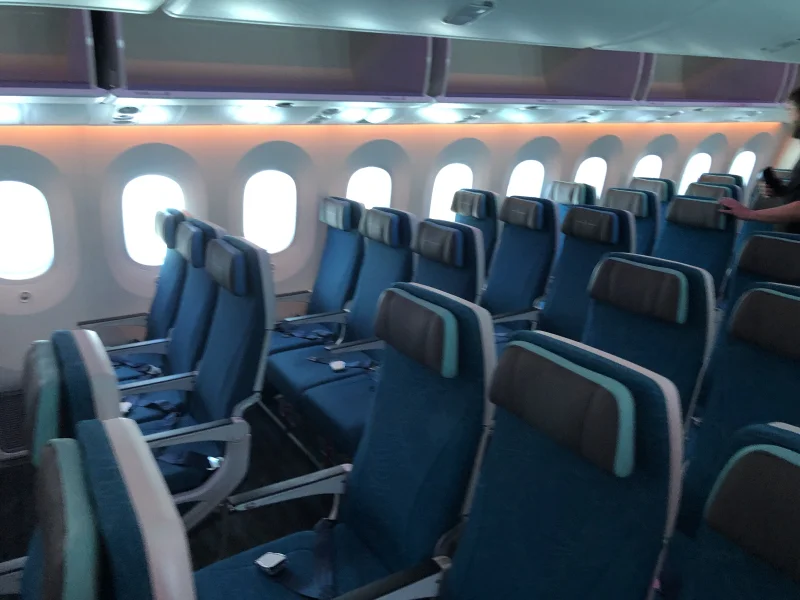
I hate being trapped on a plane like a sardine, feeling claustrophobic, unable to open a window.
I hate sitting for so many hours, and it’s terrible for my back.
I hate how there are always people coughing in such close quarters, spreading threatening germs when feeling healthy is so important.
I hate how vulnerable I feel up in the sky, at the mercy of so many things beyond my control.
Embarking on this novel challenge, I remembered a technique I learned from Martha’s book Beyond Anxiety: tapping into the power of the inquisitive “Hmm.”
Martha has people say “Hmm” while looking at an object, person, or situation, and then notice how that tiny questioning sound immediately stimulates their curiosity about whatever they’re observing. “Where anxiety makes us avoid more and more of the world, curiosity draws us forward, helping us get used to unexplored environments and unfamiliar experiences,” Martha wrote. “Anxiety retracts; curiosity expands.”
Sitting with a curious “Hmm” about my fly-hating suddenly gave me the ability to step back and observe my previously unexamined belief. Instead of being blindly ruled by it, I became interested, treating it as one possibility among many. This shift of perspective had an astonishing effect.
I saw how much sticking with my “I always hate to fly” belief usually impacted me long before my travel began, which reinforced the idea that flying was miserable while I was still comfortably at home. Instead of meeting each trip as a new experience, I had been reflexively projecting my negative past experiences onto an unknowable future—viewing it through an old lens rather than allowing it to reveal itself organically.

To my amazement, instead of the dread of flying that usually kept building in intensity as my departure date neared, I became increasingly excited about my upcoming vacation, focused on the reasons the trip was initially planned. I felt buoyant, happy that I would soon have the opportunity to swim in a warm tropical ocean and relax with my husband without our routine responsibilities. This was in sharp contrast to my usual apprehension, which was heavy and depleting.
The impact of investigating my absolutist belief was so dramatic that on the way to the airport, instead of steeling myself, I was genuinely eager to see how the travel would unfold.
At the terminal, I noticed how my previous attitude would have interpreted every inconvenience, delay, and discomfort as additional evidence that flying was something incredibly unpleasant that I was forced to endure. But this time, firmly rooted in my observer perspective, I was calm—a grounded explorer open to all possibilities.
I felt pleasantly neutral about the whole experience, and the neutrality was relaxing. Emotional drama uses a lot of energy. And as someone who is extremely challenged when it comes to unwinding my nervous system, being able to stay serene while traveling felt like a triumphant accomplishment.
In the air, I was mesmerized by the glorious cloud formations I wouldn’t have been able to see any other way. Despite a baby crying in the row behind me and the uncomfortably cold cabin temperature, when we landed, I was upbeat and relaxed.

I kept my experiment going for the return trip, gleefully in awe about my newfound freedom to experience traveling so differently. It became clear to me that so much of my response to life is less about what I am doing, and much more about how I am doing it. I also began to see that many of the absolutist thoughts I generate (like “I always hate to fly”) are not objectively true. Rather, they are recycled data from the past—old experiences, assumptions, and conclusions that I habitually accept as fact.

Since I’ve been home, I’ve been applying Martha’s advice to numerous absolutist beliefs, particularly ones that involve other people. It’s all too easy to fall into the trap of being hyper-critical by saying someone is always something negative—always late, always impatient, always aggressive, always uptight. Challenging these beliefs is allowing me to see just how much of what I perceive comes from my own projections, which helps free both myself and others from fixed identities and old narratives while giving me more agency over my life.
I’ve been greatly benefiting from Michael A. Singer’s new book, Wisdom Untethered, in which he shares many insights about how to release the patterns that block our innate peace, freedom, and joy. This passage feels especially relevant to these current explorations:
You walk through life with a constant whisper inside, telling you what you want and what you don’t want—what should happen and what shouldn’t. These desires and preferences feel so personal, so justified, but they’re actually just the residue of past experiences stored inside of you. You think you’re choosing them, but in truth, they’re choosing you. The more you listen to them, the more your life becomes a struggle to make reality match your inner needs. But what if you didn’t have to do that to be okay? What if you could let go of the need for things to be a certain way—and still be completely okay inside?
I’m grateful to Martha for pointing out how the simple act of challenging absolutist statements can open us up to a much bigger, brighter world. Every time we replace certainty with curiosity, we have the opportunity to wipe the slate clean of old assumptions about ourselves and others, and meet the present moment with fresh eyes and a greater capacity for compassion and joy.